Sunday, January 20, 2008

Grommet in North Philly

If you want an architect to sign up for your social cause, show him how it messes up a nice building.

On March 14th 2006, I had only been in Philadelphia for a month. I was working as a project architect for Wallace Roberts and Todd and we were working on housing projects for the local housing authority, Philadelphia Housing Authority (PHA). Well I was in for a surprise. A couple of architects and I were visiting a site for a project we were doing for the PHA in North Philly.

I had never seen anything like North Philly in San Francisco and was stunned and confused by it.

Things that I don’t notice now, having been here a year, were jumping out at me then. Camera in hand like a tourist, I was taking pictures of everything in this poor neighborhood. Everything burned into my mind intensely. I had never seen such a place. I could not believe that such beautiful houses were being let to rot away. In SF these buildings would have been prizes, gems, objects of reverence. Here in Philadelphia they were just the accessories to an indelibly hard neighborhood. I just could not get it. So, camera in hand, I shot away.

I was wondering at the time, where is the outrage that this is happening to people and these houses? Why is no one sweeping in and taking care of these buildings? Where is the help for North Philadelphia? Surely there would be change in the year if good people knew. Do the people on the Main Line (a fine neighborhood outside of Philly) just not care?

Now I know. It’s easy to accept things. But you don’t accept what is happening in North Philadelphia consciously. It just creeps away as you get on with other things. Nowadays, I remember my concern when the newspapers put it in front of me while I ride the R7 Train. This person shot. That person shot. And I can see it outside the train window. I see the neighborhoods tumbling in on themselves. You can see it is hard. But now it just seems like a large something that is here like a lot else: the train, and the weather and the flat rolling hills.

As I have been thinking about this, I realize that there is another side to my story – and that is Oakland California. San Francisco is not a place of magically concerned people who wouldn’t let this happen to the people around them. The grittiness of 14th street in Oakland is invisible from San Francisco. San Francisco can’t see West Oakland. San Francisco can not see Richmond CA. It does not get off at the 11th street exit and take a look around. It is on its way to Marin - or the Cheesery.

What’s my deal anyways? I was in and out of those neighborhoods enough to know the deal. Heck, I bought my second 280z in a neighborhood in Union City California that was just the kind of neighborhood I am talking about. As a matter of fact, I remember right after I bought it, an awfully nice man from the CHP pulling me over before I could hit 55 on I-880. Why? Because there was a warrant for the arrest of the previous owner and – well – they profile Z’s....

And I did get off at the 11th Street exit in Richmond CA all the time. The foundry that cast much of my furniture is there. So why my shock about N. Philly?

In San Francisco you can get along very well with out seeing poor people stuck in the arcs of their lives because The Bay holds everything at a distance. It also helps that in the Bay Area, poverty happens in ranch houses – not in tall brick Victorians.

Ranch houses don’t look so shocking to an architect as they implode.

Here is one of my concept sketches. I was trying to get away from language of the Victorians and Colonials that so dominate the neighborhood. I was trying to bring forward the Scandinavian substrate that is under it all here (since the 1600's) rather than rely on the default philly colonio-victoriana. I was also thinking of something new without connotation that could be adopted by the people living there - something that would help rebrand existence. Something not branded as poverty.

Are architects shallow for not reacting to poverty until the buildings look like crap? No. Look at it this way, we are the people who think that buildings can save the world. So when we see them falling apart - we see the inverse. We see that the world is falling apart. And we react. We work for the PHA and try to put it back together. Of course things get by us. I missed the grinding poverty in Richmond's ranch houses.


And most architects know that better buildings aren't enough. But it is the part we can help with. A part, hopefully, of a big fix (TBD).

Monday, January 07, 2008

Liquid Lines


As I live longer and longer in Philadelphia, I am beginning to overlook things. It’s coming up on 2 years now for me that I have been here. I walk across Broad Street several times a week, often stepping off from the corner controlled by the Union Club. I don’t notice the club all that much any more; which is too bad. I just came across this photo I took when I first arrived in Philadelphia. Everything was exciting. And the lines of this staircase where just amazing.

Thursday, October 04, 2007

Kinetic Beach Sculptures

Beautiful kinetic sculptures. A beautiful melding of the winds we feel on the beach with ...stuff. By Theo Jansen.


His website... StrandBeest

An explanation without words on how one beast works:

Thursday, September 06, 2007

Heath Ceramics at DWR SF Fillmore

If I were in SF next week I'd be at the DWR hosted lecture by the people at Heath Ceramics

Here's the deal if you didn't follow the link:

"Heath Ceramics at DWR
Thursday, September 13, 6-8pm

"Heath Ceramics was started in Sausalito, California, in the mid-40s by Edith Heath, who believed that the hand of the maker should be visible in all of her designs. Present owners Robin Petravic and Catherine Bailey purchased the company in 2003 with the intention of continuing Edith Heath's legacy as a designer, the company manufactures Edith's classic designs, as well as new designs in the original Sausalito Factory. Join us [DWR] for a lecture by the couple who will focus on Heath's history, her philosophy and how it influences us today. DWR has just introduced a bowl set with a glaze combination that's exclusive to us. Join us for an educational evening about a local institution. Refreshments from Izze soda will be served. RSVP to fillmore@dwr.com by September 11. "

Heath is interesting if nothing else because - well - how can you afford to live in the Bay Area if you're not in tech or banking? Maybe someone will ask at the lecture....

Saturday, August 25, 2007

Critical Theory is so… MySpace.

The most limiting aspect of modern culture is the restriction on the expression of harmony. Like adolescents absorbed with the sudden realization that their parent’s aren’t so perfect, the culture scene is convinced that harmony and beauty are lies covering up an ugly world of truths. Over and over again the point of reference for the cultural critic is that at the base, everything is sad, wounded, ugly and mean. Here is one day's worth of quotes from the New York Times:

"The freakish is the ultimate avant-garde, a finger in the eye of the buttoned-up bourgeois vision of ordered life, like a tattoo parlor in the midst of a holistic spa."

From a review of Ripley's Believe it or Not in NYC entitled, "O, Believers, Prepare to Be Amazed!"

By EDWARD ROTHSTEIN
Published: August 24, 2007

Next quote...

"This rigged group-therapy session, whose facilitator wears a frozen smile and addresses the assembly in the unctuous tones of a grade-school teacher, is the only scene in the movie to hint at the rot under the charade. Nothing is allowed to disturb the fantasy of perfect moms making perfect lives for their perfect children. For an ugly, satisfying moment, the rock is lifted."

In a review of the Nanny Diaries, "The Devil Wears Down Her Nanny"

By STEPHEN HOLDEN
Published: August 24, 2007

When does the academy of criticism grow up? When is adolescence over? When do the critics begin wandering about as adults? When does the complex realization that the world is both genuinely hard and beautiful arrive and that, ultimately, it is the beautiful that must win or at least be cheered on if life is to make any sense - cheered on not in blindness but in full awareness of everything that sucks about life?

Thursday, August 16, 2007

Fashion in Architecture

Question: is an interest in style and fashion in architecture too lowbrow for the serious architect? Isn’t fashion something that is terrible?

Another Question: If Design connects us to God and God is timeless, where do trends fit in? Trends evaporate – buildings stand forever. Is the architect who designs consciously in the current style a bourgeois oaf creating an irrelevant veneer hiding us from the real?

I say no way.

Fashion and time are united. We are incarnated by God in a world where time is a significant element. And because of time we are allowed movement. Our motion through our times and culture writes a story – it creates a narrative – a unique narrative. Bringing that story forward into our design is the role of trends. Giving us delight in being part of our historically unique narrative is the role of fashion and trends.

Trends and style are celebrations of being alive in our unique story. The story of my life is so different from my parents, and the story of my culture is so different from those that came before it. I want to put that awareness into my designs, so I will use style and fashion to do that.

What about timeless design? Surely my life and culture isn’t completely different from the lives and cultures that proceeded mine. I can feel the universal and timeless thread in me. I want that thread in design so that I am in a good relationship with my ancestors. My awareness of my grandmother Vera, my great-grandfather John, all my ancestors and the cultures they came from is the foundation of meaning in my life.

So design simultaneously expresses both timeless ideas and the fashionable. It’s the denial of this that makes Bauhaus style seem mean to me. The Bauhaus so focused on the timeless (basic geometric elements of form) at the expense of ornament (fashion). …But then it’s amazing how quickly the Bauhaus became fashionable. Modernism quickly became an ornament; the fine jewelry of the bourgeoisie.

While designing in trends can be overdone in the same way drinking wine can be overdone, there is transcendent beauty to be found in working with current styles and fashion. It’s good for Designers to find a way to work with this language even if it seems as volatile as acetone.

Not that there isn’t danger. We just need to keep an eye on the dark side: obsession with style’s the equivalent of being drunk. Otherwise finding the art in designing with an awareness of current fashion, trends and style is not the pursuit of something base and beneath us. It is a good skill for an architect to have.

Thursday, August 09, 2007

Pattern-Text

To make analysis of architecture possible, I have chosen to see buildings as being composed of patterns.
These patterns - infused with attitude, bias and ideology - communicate through pattern-texts. In these pattern-texts can be found the ideology of the building (though not necessarily that of the architects).

The pattern can be understood to be the solution to a problem. For example, a problem may be how to get light to a person in a building. The solution could be a window. The window is the pattern.

two cats enjoy the window

Puck and Coal enjoy the view of Mill Valley (well the birds, actually).

Underlying this pattern is an assumption about human needs. And the needs that are acknowledged reveals a whole lot about how people analyze people. Some lists of needs the result of unrelenting measurability, reveal a commitment to scientific rationalism and others a more holistic system of analysis.

So there is a perspective – an ideology – attached to a pattern that will be determined by how the problem is defined. Is the problem to get light to a person because a person needs a certain number of lumens to read by, or is the problem to get light to the person so he can see what he is doing AND to provide him with the choice of seeing a view and seeing that light in itself is beautiful? The former advocates scientific rationalism as the tool for defining needs. The later acknowledges the measurable needs but also advocates seeing needs that cannot be measured with anything other than the artful application of intuition and wisdom.


Tuesday, July 31, 2007

BWAF Issue 2: New Fellows

Architect and friend Beverly Willis, FAIA, has sent out her second email newsletter today.

If you are a woman in architecture or a woman architect (sorry for redundancy here – just typing key words for Google) you should be aware of Beverly and her grants to women architects. Beverly not only supports women in architecture, she is also an impressive architect herself: she has fought the good fight, has a good soul and keeps the BS level down ( that alone should make her notable in the profession).

Tuesday, March 20, 2007

Hale Building: Philadelphia

Over and over again the Hale building on Chestnut Street appears in my mind when I think of Philadelphia. This kind of building doesn’t exist in the cities where I came from – Los Angeles, San Francisco, Eugene, Tacoma, Seattle.


It’s a mysterious and evocative building. Obviously inhabited by its own soul – I doubt whoever owns it can do much more than observe the affairs that swirl around this property of theirs.


Beings come and go in the purple hours before dawn visiting someone great who lives and watches from the top stories.


The decaying posters along the sidewalk unfold at night to become the wings of creatures who fly off.


Windows are blackened but faces appear and disappear without a sound.


You’ll feel a tug at your pant cuffs as the breeze from an invisible overcoat curls down the wall, levels out and goes past you, making its way down the sidewalk.


Here’s more information from the Philadelphia Buildings and Architects website.


Designed in 1887 by Willis Gaylord Hale (1848 - 1907) across the following addresses:
1325-1327 SANSOM ST
1326-1328 CHESTNUT ST
100-120 S JUNIPER ST

Saturday, March 10, 2007

Martha's Style

Every month I can count on Martha Stewart Living magazine to serve up a few amazing images. The March 2007 winner is page 147. The whole page. This bleed-to-edge image transports me. I also had feelings when I first saw it that were hard to track. It felt familiar. To be exact, the feeling that is dreamy-ness mixed with excitement mixed in with expansiveness felt familiar.

After holding this for a minute it struck me that the bleed- to-edge blue sky is something that I saw in magazines of the 60’s – maybe Sunset magazine.


Almond Blossoms in Springclick on image to see it a bit larger...

So that is what comes up for me. Just a hint of when I was a kid some Spring in Los Angeles - some moment under gorgeous blue skies searching for the last bits of snow on Mt. Baldy.

So hats off to Sally Gall (Photographer), Denise Clappi (Director of Design Production), Heloise Goodman (Photography Director) and everyone else involved at MSL.

Monday, February 26, 2007

No really, I'm here.

Yep. I haven't posted in-- yipes! -- a month. I've just been busy. Lots going on. I will be back soon though.

Thanks for coming by.
-Mark

Friday, January 26, 2007

Build a Tibetan temple

The Tibetan Heritage Fund has a wonderful Flash piece on how to build a small Tibetan temple. This may prove useful to you at the next family get-together.

It takes a minute to load (the Flash piece). You may think nothing is happening. But something is happening in the nothingness of it all. You'll have no notice when it finally loads so just keep clicking on "next" every 15 seconds or so-- maybe with each breath. When you see the red circles click on them. They’re drill down points. Also don’t miss the express tour using the “quick menu”.


And put your volume on low. At the end of your self guided tour, little tampers will walk across the roof singing.


Building a Tibetan temple
Really honestly – wow. Who ever made this has so much love for these buildings.

Disconnect

Sometimes conversations are like this.

Sunday, January 21, 2007

Architects and self-knowledge

Is it enough to be an architect focused on concept?

More often than not, design decisions based on a concept rule if you are hoping to be a critically acclaimed architect. Your building must be saying something political. It must challenge. It must engage in discourse. I did not always know that.

At U of Oregon, I was taught by Bill (“William”) Kleinsasser
that architecture is about meeting human needs. That resonated with me – it put words to some thoughts in my 19 year old head. I believed our chore as architects was to find human needs and then wrap them in architecture. Here are some of the needs he taught us to design for:
-Insideness (enclosure, security)
-Changeability (variable)
-Repose
(William Kleinsasser. Synthesis 9. Eugene, OR: self published, 1999 p 228.)

His list is a little funky. It’s sometimes hard to know if these are needs, needs above greater needs or the solutions to needs. But you get the idea. These needs also aren’t physiological needs. The needs Bauhaus used to guide the design of worker housing - light and air – after being cooped up in smoky slums near factories were very much measureable and physiological.


Kleinsasser also wisely didn’t assign them to either psychology or spirituality.  They don't make sense because you made them make sense. They are just needs you understand after years of building self-knowledge by patiently watching your feelings and mind at work as you experience architecture.

Later at UC Berkeley, I studied that architecture was media instead of a container that met a person's needs. We talked about buildings as if they were big TVs. We learned from semiotics to understand all designed things as books that present messages. Additionally these messages that all designed things held were to be understood in the terms of the cognitive connections they catalyzing in us through gender and cultural associations.


That made architecture live vividly in my mind but did nothing to illuminate my experience of a building or how to design good experiences. It was all about designing good messages.

I miss Kleinsasser’s idea, although I enjoy both perspectives – architecture based on human needs and architecture as presenter of concept.

Few writers have captured the necessity of architects to explore their own consciousness better than Alain de Botton in his book “The Architecture of Happiness”. Here’s a quote ( NOTE: De Botton is both a good writer and horrible at it. I’ve rewritten the quote. The original will be at the bottom of this post).

“To design means forcing ourselves to unlearn what we believe we already know. It requires us to patiently take apart the mechanism behind our reflexes and to acknowledge the mystery and stupefying complexity of needs we are seeking to meet behind every day gestures like switching off a light switch or turning on a tap.

“No wonder so many buildings don’t satisfy. They provide sad testimony to the arduousness of self-knowledge. No wonder there are so many rooms and cities where architects have failed to convert an unconscious grasp of their own needs into a reliable understanding for how to satisfy the needs of others through design.”

His words have brought my thinking into crisp focus. It’s not enough to study semiotics. It’s not enough as an architect to be singly focused on the communication of concept.

An architect has to be focused on human needs and can only partly understand without understanding their own.

Here, maybe, is Koolhaas coming to the same conclusion,
“I think one of the important evolutions is that we no longer feel compulsively the need to argue, or to justify things on a kind of rational level. We are much more willing to admit that certain things are completely instinctive and others are really intellectual.”

This is the next step in design. The ability to simultaneously handle methodologies for design that once seemed counter to each other is becoming the high art of the architect.

--------------------
Here is de Botton’s original text from page 247 of his book “The Architecture of Happiness”.

“To design means forcing ourselves to unlearn what we believe we already know, patiently to take apart the mechanism behind our reflexes and to acknowledge the mystery and stupefying complexity of every day gestures like switching off a light switch or turning on a tap.

“No wonder so many buildings provide sad testimony to the arduousness of self-knowledge. No wonder there are so many rooms and cities where architects have failed to convert an unconscious grasp of their own needs into reliable instructions for satisfying the needs of others.”

Thursday, January 04, 2007

License Developers

I think the idea to license developers is a great one. Before we let architects practice we run them through a battery of tests -- after 8 years of combined schooling and work experience. But their impact on our environment is small considering that they must work within the visions of developers.

It’s this “within the vision” part that is of concern. Developers aren’t trained in city planning, the importance of aesthetics or urban design, but it is they who determine what is going to be built in our world. Developers control the programs and the magnitude of projects. They determine the style and just how much money the architect can spend on design and materials. As a result it is they, not architects that determine the success of things like public transit, the level of urban congestion, the quality of design and the atmosphere of the place.

Sure, zoning boards have some power as well, but the current system leaves it up to the architects and city officials to restrain/educate them. If it sounds like a battle… well it sure looks like one in practice. There just isn’t that much restraining that can be done. And doesn’t that put architects in the position of condescending to developers? Every developer I’ve met has been smart. I’d rather that they came to the table in a position that defines their responsibilities and capabilities. It would make things less strenuous. Instead there is often a silent and unsettling battle around a project.

Many believe that it is the architect’s role to educate the developer in the course of developing designs but this belief is not realistic. At best you get a developer who is already enlightened choosing a good architect and deciding to give them a program and budget that will allow them to be successful. This is decided before the architect is ever contacted. At the time the developer steps through the door of the architect’s office, the game is set. There won't be any more education.

There are many good developers out there and I’ve been lucky to have been working with many just recently. But when I read the Philly Enquirer and look at the projects it shows being proposed I think we need to require that developers have a little schooling on urban design and city planning before they go to bat. Why can’t we ask that they understand the importance of design to a culture and user? It is they, not architects, who make the master strokes in our cities.

I also think that requiring licenses could turn out to be to the advantage of developers. Listing the licenses, education and specializations behind them would only encourage investors to trust a developer. Licenses would also demonstrate to community groups a developer’s ability to be thoughtful and concerned for a neighborhood rather than capricious and disengaged.

Drake Post Follow-Up

Yes, the sky was really that yellow.

Friday, December 29, 2006

Winter Light/Afternoon/Drake Hotel

The office has gotten very still. It’s Friday afternoon. It’s been quiet all week. Outside my window the Drake Hotel is in the warm glow of the setting sun. ...or the Drake IS a warm glow outside my window.

The Drake Hotel in Philadelphia

The Drake Hotel


I am bothered by the flatness of Philadelphia. I have this little ache in my chest as I think of walking the Miwok and Mt Tam's trails just north of SF. These trails amble and wind over grassy hills high above the coast with a solid nonstop view of the Pacific.


View from Pop O'Rourke's bench on Mt Tam

View down the coast from Mt Tam.


But SF doesn’t have buildings like the Drake. I see this building and I think someone must have asked for a whole landscape on top of this building to make up for the Delaware valley flats. SF has, more or less, a cranky pile of flat topped modern buildings downtown. Philadelphia's downtown buildings have much more magic in them.

I can imagine myself anywhere up on this building; sitting on terraces, lounging under arches, reading by windows.

The sun is about set. Time to wrap up here and head home.

As I finish this it has gotten darker. Looking to the west the sky is fuchsia with orange contrails darting down to the horizon. The Drake has disappeared into the dark.

Saturday, December 02, 2006

Butterfly Roof

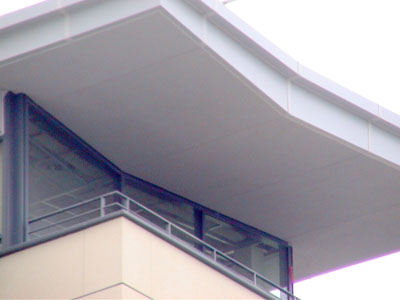
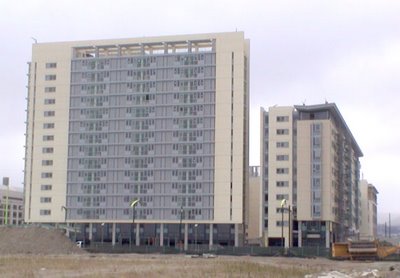
Butterfly roofs are hard to do well. The best I’ve seen is on the UCSF, Mission Bay Student Housing.

UCSF butterfly roof
It’s subtle but there is a lot going on here that makes most other butterfly roofs look like blunt interpretations of the definition. Try a google search and you’ll see what I mean. Here the angle is not too great. The tapering thickness refined. There’s just enough asymmetry between one wing and the other to make it interesting. Most butterfly roofs I’ve seen are either so thick or so balanced that they lose any dynamic. Many simply look like the lid of an old trunk flipped up.


Props to Fisher Friedman Associates
who worked on this in partnership with Skidmore Owings & Merrill (I won’t link to SOM website. The UI is unnavigable. The search functionality too problematic) Butterfly roof

I would love to know who the individual was that did this. Buried in the team credits there must be one person who lent their own personal sense of proportion and balance to this.

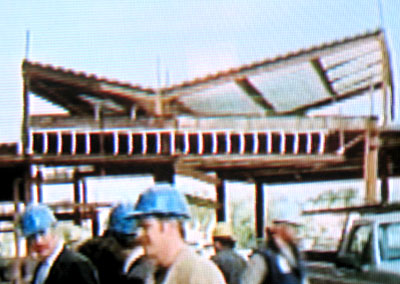
The construction pic is taken from my TV. The roof - in fabrication - showed up amazingly in an episode of Monk (Mr. MONK CAN'T SEE A THING (#501) EPISODE PREMIERE: July 28, 2006)


butterfly roof on monk
That’s Captain Leland Stottlemeyer on the left.


The butterfly roof is also part of a very nice larger composition. The designers have created an occupiable space at the top of the building. This old school idea has been dropped from most modern buildings. Rather than terminate in a crisp scale-less sheet of framed glass the designers created a bit of something for the imagination at the top - a place at the top of a building where your eye can rest and wonder what it would be like to be up there. Classical buildings often give me something up top to fantasize about: wondrous views and glamorous people who wander high up on terraces outside glorious and warm rooms. It gives a building some magic. It’s cool that a modern building in the 21st century should pull this out of the bag.

Monday, November 13, 2006

LEED Home (Residential): Party like it's 1975?

The USGBC will soon release LEED guidelines for homes. Right now the focus of certification is on commercial buildings. I'm a LEED AP and I support what the USGBC is doing but I have a thought on the new LEED Home (residential) guidelines.

I think the USGBC should give you 2 different tracks towards LEED certification for the home;
A. the elaborate series of points they will come up with, or B, You can achieve LEED Platinum simply by designing your home to conform to the average size of a home from 1975. Drop any energy saving requirement. Forget water efficient landscaping. Just build less even if it’s a mess in so many ways.

The average home of 1975 was 33% SMALLER than the average home of 2005. In 1975 59% of the homes had 1.5 bathrooms or more compared with 96% in 2005. It makes me think, could the Master Bath be what is killing the planet, not the heat island on the roof?


I'm thinking of the Graphic below culled from the SF Gate article entitled, “Americans like supersized homes- Families and plots are smaller, but people want more bedrooms, bathrooms and garage space”, which in turn was partly culled from Washington Post and a graphic by Marianne Seregi.


Graphic from Washington Post by Marianne Seregi


I am guessing that the home now is so bloated compared to what we built in 1975 that for everything the USGBC will accomplish with their new residential LEED certification standards, they’d accomplish more just throwing in the towel and saying,

“Look, just build it like you would have in ’75. As leaky and inefficient as it was, that house is going to burn up less resources than your LEED platinum home of 2007. There will be one less toilet, 30% more forest from the 2x’s you WON’T be using, and scads of less air to heat or cool. Just send us a picture and we’ll send you the plaque”.

Wednesday, November 08, 2006

Managing Ideas

When I was a kid in Tacoma, every morning I would remember seeing Mrs. Clark's light on in her window across the alley. You'd think that nothing very cultural was going on in Tacoma in the 1970's but Dorothy Clark was up early every morning before sunrise to write. Under a deep black sky going to blue she was typing out plays and her writing.

For all the technology out there I am still having difficulty managing all of the ideas I have. I'm just not getting them written down. Technology isn't the only problem, time management is also a big deal.

There are a million ways to capture ideas when they come. Right now the best I have are my sketch book and 3x5 cards. Don't suggest PDA's or laptops. Been there. Not gonna work.

And I'm still I'm not getting great ideas written down. They are given to me and then they pass away.

When I lived in San Francisco I had a friend (still have actually), Herb Gold who is a writer. He would write in the morning as well. First thing? I don't know. I know that a swim at the old JCC was part of many mornings, but I don't know what came first. I just know that I would knock on his door unannounced in the morning only once. I came by around 10:00 AM one day and he was in full swing. Normally friendly he sent only his most legally polite and terse self downstairs to the door to tell me never again! Call before hand! "I write in the morning!"

Got it. So maybe the solution to writing, capturing ideas and so on is writing in the morning. It's simple and that specific. Choosing a technology to capture it is only the next step.

I resent this and bridle against the restriction. Certainly connecting inspiration to an audience is too general and wide and God given to be subject to a simple requirement - "write it in the morning or forget writing most of it."


But I think the solution IS to get up early and do it. At least for me.

Early in the morning. No other time of day. And knock it out. Get those ideas written on all the scraps of paper typed out.


Now I'm going to be late for work. I don't know how Mrs. Clark got up so early but it must be done.

... gotta run.