Pics taken while waiting for the train at the 46th Street Station,above the intersection of Farragut in Philadelphia.

Pics taken while waiting for the train at the 46th Street Station,On
I had never seen anything like North Philly in
Things that I don’t notice now, having been here a year, were jumping out at me then. Camera in hand like a tourist, I was taking pictures of everything in this poor neighborhood. Everything burned into my mind intensely. I had never seen such a place. I could not believe that such beautiful houses were being let to rot away. In SF these buildings would have been prizes, gems, objects of reverence. Here in
I was wondering at the time, where is the outrage that this is happening to people and these houses? Why is no one sweeping in and taking care of these buildings? Where is the help for
Now I know. It’s easy to accept things. But you don’t accept what is happening in
As I have been thinking about this, I realize that there is another side to my story – and that is
What’s my deal anyways? I was in and out of those neighborhoods enough to know the deal. Heck, I bought my second 280z in a neighborhood in
And I did get off at the
In
Ranch houses don’t look so shocking to an architect as they implode.
Here is one of my concept sketches. I was trying to get away from language of the Victorians and Colonials that so dominate the neighborhood. I was trying to bring forward the Scandinavian substrate that is under it all here (since the 1600's) rather than rely on the default philly colonio-victoriana. I was also thinking of something new without connotation that could be adopted by the people living there - something that would help rebrand existence. Something not branded as poverty.
Are architects shallow for not reacting to poverty until the buildings look like crap? No. Look at it this way, we are the people who think that buildings can save the world. So when we see them falling apart - we see the inverse. We see that the world is falling apart. And we react. We work for the PHA and try to put it back together. Of course things get by us. I missed the grinding poverty in Richmond's ranch houses.
And most architects know that better buildings aren't enough. But it is the part we can help with. A part, hopefully, of a big fix (TBD).

The most limiting aspect of modern culture is the restriction on the expression of harmony. Like adolescents absorbed with the sudden realization that their parent’s aren’t so perfect, the culture scene is convinced that harmony and beauty are lies covering up an ugly world of truths. Over and over again the point of reference for the cultural critic is that at the base, everything is sad, wounded, ugly and mean. Here is one day's worth of quotes from the New York Times:
"The freakish is the ultimate avant-garde, a finger in the eye of the buttoned-up bourgeois vision of ordered life, like a tattoo parlor in the midst of a holistic spa."
From a review of Ripley's Believe it or Not in NYC entitled, "O, Believers, Prepare to Be Amazed!"
By EDWARD ROTHSTEIN
Published:
"This rigged group-therapy session, whose facilitator wears a frozen smile and addresses the assembly in the unctuous tones of a grade-school teacher, is the only scene in the movie to hint at the rot under the charade. Nothing is allowed to disturb the fantasy of perfect moms making perfect lives for their perfect children. For an ugly, satisfying moment, the rock is lifted."
Published:
When does the academy of criticism grow up? When is adolescence over? When do the critics begin wandering about as adults? When does the complex realization that the world is both genuinely hard and beautiful arrive and that, ultimately, it is the beautiful that must win or at least be cheered on if life is to make any sense - cheered on not in blindness but in full awareness of everything that sucks about life?
Question: is an interest in style and fashion in architecture too lowbrow for the serious architect? Isn’t fashion something that is terrible?
Another Question: If Design connects us to God and God is timeless, where do trends fit in? Trends evaporate – buildings stand forever. Is the architect who designs consciously in the current style a bourgeois oaf creating an irrelevant veneer hiding us from the real?
I say no way.
Fashion and time are united. We are incarnated by God in a world where time is a significant element. And because of time we are allowed movement. Our motion through our times and culture writes a story – it creates a narrative – a unique narrative. Bringing that story forward into our design is the role of trends. Giving us delight in being part of our historically unique narrative is the role of fashion and trends.
Trends and style are celebrations of being alive in our unique story. The story of my life is so different from my parents, and the story of my culture is so different from those that came before it. I want to put that awareness into my designs, so I will use style and fashion to do that.
What about timeless design? Surely my life and culture isn’t completely different from the lives and cultures that proceeded mine. I can feel the universal and timeless thread in me. I want that thread in design so that I am in a good relationship with my ancestors. My awareness of my grandmother Vera, my great-grandfather John, all my ancestors and the cultures they came from is the foundation of meaning in my life.
So design simultaneously expresses both timeless ideas and the fashionable. It’s the denial of this that makes Bauhaus style seem mean to me. The Bauhaus so focused on the timeless (basic geometric elements of form) at the expense of ornament (fashion). …But then it’s amazing how quickly the Bauhaus became fashionable. Modernism quickly became an ornament; the fine jewelry of the bourgeoisie.
While designing in trends can be overdone in the same way drinking wine can be overdone, there is transcendent beauty to be found in working with current styles and fashion. It’s good for Designers to find a way to work with this language even if it seems as volatile as acetone.
Not that there isn’t danger. We just need to keep an eye on the dark side: obsession with style’s the equivalent of being drunk. Otherwise finding the art in designing with an awareness of current fashion, trends and style is not the pursuit of something base and beneath us. It is a good skill for an architect to have.
The pattern can be understood to be the solution to a problem. For example, a problem may be how to get light to a person in a building. The solution could be a window. The window is the pattern.
Puck and Coal enjoy the view of Mill Valley (well the birds, actually).
Underlying this pattern is an assumption about human needs. And the needs that are acknowledged reveals a whole lot about how people analyze people. Some lists of needs the result of unrelenting measurability, reveal a commitment to scientific rationalism and others a more holistic system of analysis.
So there is a perspective – an ideology – attached to a pattern that will be determined by how the problem is defined. Is the problem to get light to a person because a person needs a certain number of lumens to read by, or is the problem to get light to the person so he can see what he is doing AND to provide him with the choice of seeing a view and seeing that light in itself is beautiful? The former advocates scientific rationalism as the tool for defining needs. The later acknowledges the measurable needs but also advocates seeing needs that cannot be measured with anything other than the artful application of intuition and wisdom.
Architect and friend Beverly Willis, FAIA, has sent out her second email newsletter today.
If you are a woman in architecture or a woman architect (sorry for redundancy here – just typing key words for Google) you should be aware of
Windows are blackened but faces appear and disappear without a sound.
You’ll feel a tug at your pant cuffs as the breeze from an invisible overcoat curls down the wall, levels out and goes past you, making its way down the sidewalk.
Here’s more information from the Philadelphia Buildings and Architects website.
Designed in 1887 by Willis Gaylord Hale (1848 - 1907) across the following addresses:
1325-1327 SANSOM ST
1326-1328 CHESTNUT ST
100-120 S JUNIPER ST


The Drake Hotel
View down the coast from Mt Tam.

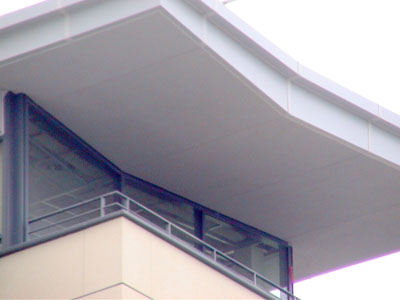
It’s subtle but there is a lot going on here that makes most other butterfly roofs look like blunt interpretations of the definition. Try a google search and you’ll see what I mean. Here the angle is not too great. The tapering thickness refined. There’s just enough asymmetry between one wing and the other to make it interesting. Most butterfly roofs I’ve seen are either so thick or so balanced that they lose any dynamic. Many simply look like the lid of an old trunk flipped up.

Props to Fisher Friedman Associates who worked on this in partnership with Skidmore Owings & Merrill (I won’t link to SOM website. The UI is unnavigable. The search functionality too problematic) 
I would love to know who the individual was that did this. Buried in the team credits there must be one person who lent their own personal sense of proportion and balance to this.
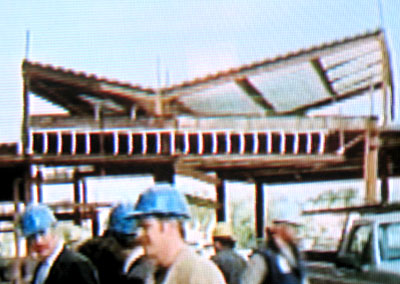
The construction pic is taken from my TV. The roof - in fabrication - showed up amazingly in an episode of Monk (Mr. MONK CAN'T SEE A THING (#501) EPISODE PREMIERE: July 28, 2006)

That’s Captain Leland Stottlemeyer on the left.
Graphic from Washington Post by Marianne Seregi
I am guessing that the home now is so bloated compared to what we built in 1975 that for everything the USGBC will accomplish with their new residential LEED certification standards, they’d accomplish more just throwing in the towel and saying,
“Look, just build it like you would have in ’75. As leaky and inefficient as it was, that house is going to burn up less resources than your LEED platinum home of 2007. There will be one less toilet, 30% more forest from the 2x’s you WON’T be using, and scads of less air to heat or cool. Just send us a picture and we’ll send you the plaque”.